Jared Ritchey: Index Faster in Google with WordPress

Jared Ritchey has a few things to say about search engine optimization and WordPress.
Jared Ritchey has a few things to say about search engine optimization and WordPress.
Michael Wnuk from Turtol recently wrote to us asking for a review of his open source content management system, TurtolCMS. He also invited CMS Report readers to review the CMS and give comments. The following is Michael Wnuk's e-mail to us about his CMS in its entirety:
My company, Turtol, is actively developing the TurtolCMS. It's an open source, design agnostic content management system targeting website owners with minimal technical expertise.
We've been using the TurtolCMS since March of 2007 for client work, at first, simply as a templating engine. Now we grant our clients access to editing tools so they can perform simple updates themselves.
Some of the new features included in the latest release of OpenEdit, version 5.622 include:
Check out the release notes for complete details.
If you are reading this post, then congratulations...you are now seeing CMS Report on its new server (a Virtual Private/Dedicated Server). As I tweak the VPS in the following weeks, I may fall back on the old server from time to time but for the most part, I'm home. Today officially ends my grand-experiment of running a moderately busy Drupal site on the cheap.
This is one of my first posts on dotCMS 1.5, so "long-time" dotCMS users feel free to correct me if I get anything wrong here. Earlier this month, dotCMS 1.5 was released. dotCMS is an open source Java based CMS geared toward toward the enterprise with Web customer resource resource management (CRM) and eCommerce, and business intelligence.
New features included in dotCMS 1.5:
On Monday, Packt Publishing announced the five finalists in each category of its 2007 Open Source Content Management System Award. The five categories are Most Promising, Best PHP CMS, Best Other (Non-PHP) CMS, Best Social Networking CMS, and Overall Winner. In the finals stage, the public as a whole is eligible to vote for each category through October 26th. While that may seem like a long time for the polls to be open, I'd encourage you to vote early so that you have no excuse for why your favorite CMS didn't make it to the winners list.
Around this time last year, Packt Publishing announced the "top five" finalists for their award (no separate categories in 2006). In 2006, those CMS projects that made it to the finalist list included Drupal, e107, Joomla, Plone, and Xoops. When those five CMS were announced, I chose to double my efforts on covering those applications here at CMS Report. Although the extra categories this year have brought quite a few more Open Source CMS into the foreground, I still don't see why I couldn't keep most of them on my CMS Focus radar scope. With 16,000 people nominating their favorite CMS for this award, that amount of generated interest is hard to ignore. Luckily, I already cover many of the CMS that did make it as a finalist...but there are still many new CMS on that list that will shake things up a bit here at CMSReport.com.
Robert Cambell announced the expected release of CMS Made Simple 1.2 with the beta version expected in a couple weeks. After the CMSMS 1.2 release all focus will be on development of a 2.0 version of the CMS.
Some of the new features and enhancements can be expected in CMSMS 1.2:
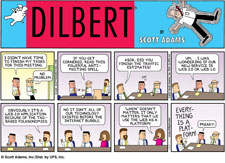 I'm always amazed how Dilbert's creator, Scott Adams, always remains tuned to the geeky side of life. This time Adams uses the "What is Web 2.0?" question as a "powerful anti-meeting" spell. You gotta love it.
Due to copyright laws, I can't show the Dilbert comic strip here. However, if you click on the thumbnail in this post...you'll magically arrive to the correct page at Dilbert.com.
"It can happen anywhere, at any time. You’re doing your job, minding your own business, and it suddenly dawns on you: you’re the company’s webmaster."
--Shane Schick, "Accidental webmasters rejoice – help is on the way", GlobeandMail.com, September 5, 2007
I found this article via Creative Commons' Science Commons. In the Financial Times article, "The irony of a web without science", James Boyle writes: