Content Management

Drive your own website

I've never agreed and disagreed so much with one article as this one from The Sydney Morning Herald, Drive your own website.

I agree...

I hate being held to ransom. And I'm sure you do, too. But that's the scenario you're creating when you hand over your website to a web designer or developer and relinquish control over when and how you can change your content...

...That's why I think it's vital for small-business owners to use their own content management systems (CMS). My recommendation is to initially use a designer to create the overall look but after that you at least want to be able to change the text on your website whenever you want.

I disagree...

If you are planning to use a free CMS, such as Wordpress, Drupal or Joomla, expect a steep learning curve and a lot of time poring through forums and blogs trying to figure out how to insert that picture just the way you want.

On the other hand, monthly subscription-based models can offer more flexibility. While you might baulk at being tied to a monthly subscription, the benefit is this is usually accompanied by technical support - so you can call or email for help

The fact of the matter is whether you're going to be using a CMS that is propriety, open source, or subscription based...there is always a learning curve involved.  The advice I often give to those looking for a CMS is to look at which CMS meet the requirements then worry about the licensing along with the how/where the site will be hosted. The fact is that if the CMS doesn't meet your requirements...no subscription-based model for that CMS is going to meet your needs.  Also, if you think Wordpress has a steep learning curve...you likely haven't done your homework on Web content management systems.  Just my opinion...
SitePress - a new mega plugin for WordPress as CMS

WordPress is the de-facto standard blogging engine and is often used to build full websites. Its power lies in its simplicity, allowing authors to start building their websites in minutes. However, WordPress is still missing some basic features keeping it from becoming a full fledged CMS. SitePress tries to close that gap.

SitePress is an ambitious mega-plugin for WordPress. It intends to turn WP into a reasonably featured content management system. SitePress contributes exactly where WordPress is short:

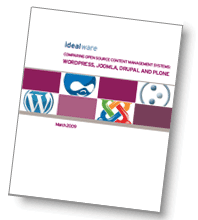
Excellent guide comparing Wordpress, Joomla, Drupal, and Plone

Image of Report PDFIdealware is providing online a report on open source content management systems by comparing Wordpress, Joomla!, Drupal, and Plone.  This 60-page independent Idealware report in PDF format provides both an introduction to the topic and a very detailed comparison of the four systems. The report also includes their new directory of the consultants and firms who help nonprofit create websites and implement these Content Management Systems.

Two CMS Worlds on Twitter

Jon Marks, a technical analyst from the United Kingdom, posted an interesting article last week on his blog.  In the post, The CMS Word on the Tweet, he discusses the difficulty of finding "his world" on Twitter when seeking conversations centered around content management system.  Jon even uses CMSReport.com's CMS Focus as an example for showing what he observes as a large divide between open source Web content management systems and propriety enterprise software.  A divide that many of us may already recognize but haven't quite put into words like Jon has.

To the Big Wide World (which includes Twitter, and all the sites I’ve mentioned above), CMS means “Free Open Source CMS with Low Cost of Ownership”. The commercial Open Source CMS solutions don’t make the cut either. Four of the five Open Source CMS products reviewed by CMS Watch (Drupal, Joomla!, Plone CMS and TYPO3) live in both worlds. Open CMS doesn’t as my feeling is it is a bit too complex. Alfresco, DotNetNuke and ez Publish made one of the lists above, but don’t really feature in the Tweetosphere.

I inhabit a world populated by analysts, commercial vendors, systems integrators, large agencies and other such creatures. I don’t believe we pay much attention to the other world until a product jumps the gap. And it seems difficult for a product that isn’t Java or Microsoft based to make it in to My World.

Jon asked me via Twitter to let him know what I thought of his article.  I think Jon has done an excellent job of identifying the dichotomy found within CMS.  It does seem that the enterprise often takes an approach to content management that differs greatly from open source projects.  The approaches differ so much that the parties involved often end up defining what is a CMS in two different ways.  The only thing I would like to comment on is that I unfortunately live on a third, yet unidentified, world that the other two worlds don't fully understand.

XOOPS Forks re-unite with their "Mothership"

The XOOPS Project, one of world’s leading Open Source CMS (Content Management System), is experiencing something that probably none of the Open Source CMS projects have ever experienced: reunification with its forks.
It's typical in the Open Source environment that developers work on a project, but then have different ideas, and leave the project to create their own forks. Most of the time they never come back.

So it's a sign of a visionary leadership of the current XOOPS team that they reached out and were able to attract back three of its recent and most innovative forks:
 
•    Simple-XOOPS under Dirk Herrmann from Germany 

The problem is bigger than SharePoint

Last week, Socialtext's Eugene Lee forwarded a link on Twitter with SharePoint as the focus of the article.  The SharePoint article is titled, SharePoint 2007: Gateway Drug to Enterprise Social Tools and the author discusses the frustration enterprises and site developers have with the Microsoft product.  There is some truth in the article as I've heard from many people discussing their concerns about SharePoint lacking quality Enterprise 2.0 features or causing vendor lock for their organization.  However, the article borders slightly on the side of a rant on SharePoint and I've allowed it remain in a tab on my browser for quite awhile while I pondered what I wanted to take from the article.

I think the frustrations the author describes about SharePoint isn't a SharePoint problem.  And the author describes the issue very well without recognizing it's just not SharePoint that drives organizations crazy.

SharePoint does some things rather well, but it is not a great tool (or even passable tool) for broad social interaction inside enterprise related to the focus of Enterprise 2.0. SharePoint works well for organization prescribed groups that live in hierarchies and are focussed on strict processes and defined sign-offs. Most organization have a need for a tool that does what SharePoint does well.

This older, prescribed category of enterprise tool needs is where we have been in the past, but this is not where organizations are moving to and trying to get to with Enterprise 2.0 mindsets and tools. The new approach is toward embracing the shift toward horizontal organizations, open sharing, self-organizing groups around subjects that matter to individuals as well as the organization. These new approaches are filling gaps that have long existed and need resolution.

The problems identified with SharePoint can easily be said about many enterprise applications out there.  Many of the enterprise suites provided to the market traditionally offered turn-key solutions in an effort to deliver a single integrated solution for the customer.  These integrated suites can and do create "vendor lock" but that isn't the sole goal of enterprise products being delivered by such companies as Microsoft, IBM, and Oracle.  The customers asked for efficient and effective enterprise solutions and the big software companies responded by providing the expected tightly controlled software platforms (historically a good thing) along with terms of licensing, predictable pricing, training, and infrastructure support.

XOOPS 2.3.3 Final Released

After over 25,000 downloads of its previous version in just three short months, the XOOPS Project, one of world’s leading Open Source CMS (Content Management System), is aggressively building on this success and has released a new version of its award winning software – XOOPS 2.3.3.

This release focused on bug fixes and usability improvements. Some of the major changes are:

  • improved profile and pm modules
  • improved installer
  • improved theme
  • improved tinymce editor

The improved installer is the highlight of this release, providing an easy way to install not only the program, but also important modules. The key for this new release was an active collaboration of XOOPS developers from around the world: China, France, UK, USA, Germany, Peru, Libya, Belgium, Netherlands, and several others. The worldwide XOOPS community is one of its strength, resulting in a quick translation of new releases into over 20 languages.

My Favorite Enterprise 2.0 Blog

Long time readers should already know that I'm a big fan of Andrew McAfee.  Andrew McAfee is the Associate Professor at Harvard Business School that is widely credited for coining the phrase “Enterprise 2.0”.  With all the traveling I did in January and February, I haven't had much chance to visit some of my favorite blog sites.  To my surprise, Andrew McAfee recently moved his blog from the business school's CMS over to his own domain and his new site looks great!

Another Wordpress, Joomla, or Drupal Comparision

Good Web Practices has a new post comparing three of everyone's favorite content management systems, Wordpress, Joomla, and Drupal [link broken].  The comparisons the author makes between the three CMS are fair as he weighs out the positives and negatives of each CMS.  Those that "get" open source will also like the way he concludes his article.