Browser

Daniel Glazman, Mozilla Composer, and Nvu's future

I have been sitting on this story for some time. Daniel Glazman has been writing a number of posts recently on a brand new project he's just starting. Daniel Glazman was involved in the development of the Netscape and Mozilla Composer (now called SeaMonkey) as well as the author of the Nvu Web authoring system. All these composers contain a WYSIWYG HTML editor and in many ways can be the considered the open source versions of Microsoft's Frontpage and Adobe's Dreamweaver.
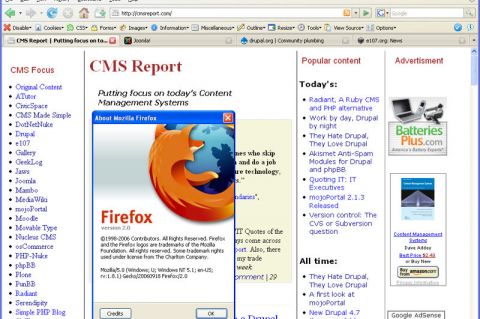

Using Firefox 2 with Content Management Systems

As you can tell from the screenshot below, I am using a release candidate of Mozilla's Firefox 2 while viewing and editing content in my Drupal site. If you look closely at the image or click on the image to enlarge it, you will also see that I don't always focus my browsing on Drupal. Take a look at the tabs and you'll see me taking a look at a number of other open source projects (such as Joomla and e107). I have been known to have 20 tabs open referencing just as many different portals, forums, and blog applications as I can find. What can I say, I'm obsessed with Web content management systems (CMS).

Headaches from security updates for Firefox and Thunderbird

Sigh...another round of security updates coming from the folks at Mozilla. It looks like version 1.5.0.7 will be at our doorsteps soon.  Now at home, updating Firefox and Thunderbird on the Windows PC is a snap since it is all automatic. However, updating in a secure enterprise environment is a different matter.

In most enterprises, most users don't have administrative privileges and without those rights Firefox and Thunderbird in most cases will not auto install the new version. What would really help is if Mozilla would provide their software in a MSI package. Until MSI packages are provided by Mozilla, it is difficult for me to accept Firefox and Thunderbird as "enterprise software". In a Windows Server 2003 environment, MSI packages are a must for easy deployment, management, and auditing.

Revised IE7 Naming in Windows Vista

No matter how big or small you are, does it not seems that the marketing department always lures us into these discussions?

I had mentioned a while back that we planned to call the version of IE7 in Windows Vista “Internet Explorer 7+”. Well, the feedback we got on the blog was overwhelming – many of you didn’t like it. So, as we’ve said on our website, we heard you. I’m pleased to announce that we’re switching the name back to “Internet Explorer 7”. No plus. No dot x. Just “Internet Explorer 7”.

Opera 9 making the headlines

Opera LogoBelieve it or not, but the first time I tried the Opera Web browser was a month ago. Until recently, I was content in calling Mozilla's Firefox the alternative browser. Opera 9 is now out and contains a wide range of features. Some of the features unique to Opera and not provided by Internet Explorer and Firefox includes BitTorrent built into the browser and Site Preferences. Site preferences allows you to accept cookies and pop-ups according to specific sites you're visiting (as opposed to settings for all sites you visit with the browser).

Firefox 2 Beta 1 has been released

Just wanted to write a quick note that the first actual beta for Firefox 2 has been released. I'm proud to say that I'm currently using the beta Internet browser as I'm writing this post. The built-in spell checker for text boxes (found in on-line forms and Web content management systems) works great! I'm also pleased to say, that the spell checker works with TinyMCE.

A couple months ago, I posted some of the features that were likely to be included in Firefox 2.0 once it reaches final release. My original list of features wasn't too far off the mark. According to the release notes, the following are new features that have been included since Firefox 1.5 was released:

Mitchell Baker: Innovation vs Stability

Mozilla's Mitchell Baker wrote an interesting post about product development. As you develop a product and customer loyalty there is a risk to making too many changes to a product. However, the success of your product likely came about because of innovation. If you kill off introducing new ideas and concepts for your product you are also likely to kill off the reason your product became successful in the first place.